
- 26.05.2026
- 10 min
- Seminars
How to organize a successful eco-responsible seminar?
Key takeaways:
The essentials for a successful seminar:
- A strong engagement driver: Organizing an eco-responsible event enhances your employer brand and unites your teams around concrete CSR values.
- The rule of the 3 logistical pillars: Priority to low-carbon transport (train, carpooling), local seasonal catering, and zero plastic.
- The strategic choice of location: Choose a human-scale establishment, such as a committed charming boutique hotel, to combine 4-star services, disconnection, and environmental respect.
- A measurable approach: Assess the carbon footprint of your event to communicate transparently and authentically with your colleagues.
Why choose an eco-responsible corporate seminar
Reducing the environmental impact of your events
Every corporate event has an environmental impact, particularly in terms of carbon emissions linked to the travel of teams attending their seminar and those of the agency staff handling the organization. Food and equipment purchases must also be part of a concrete approach. Whether you are in Lyon, Versailles, Paris, or anywhere else in France, you have everything to gain by organizing a sustainable seminar. For an eco-friendly and sun-drenched venue, contact the team at the Boutique Hôtel Entraigues, who will help you organize a seminar in the Gard department.
Strengthening your employer brand
Today, every company must consider its employer brand to attract the right talent. An increasing number of executives, team leaders, and young professionals care about the environment and want to work in sustainable spaces. Some may even look into your company's carbon footprint. Demonstrating respect for the planet is therefore essential, and a corporate event such as a nature seminar, for instance, is an excellent way to do so.
Uniting teams around sustainable values
An eco-friendly seminar enhanced with a few team-building activities helps to unite your team around sustainable values and convey your approach in a fun way. Organize workshops and choose a location that promotes environmentally friendly practices for total immersion, thereby improving team cohesion while fostering their engagement.
The 4 pillars of an eco-responsible seminar

Choosing an eco-responsible seminar venue
The choice of venue for your green seminar contributes significantly to reducing your company's carbon footprint and overall environmental impact. A seminar cannot be improvised: you must study the CSR policy of the event venue in advance, finding a conscious, accessible location with an experienced team in organizing this type of project.
Limiting travel and prioritizing proximity
A venue close to home will always be better than a distant one that requires a flight to reach. Prioritize French destinations that align with CSR policies and are accessible by train and bus. If you choose a seminar in Uzès, you tick all these boxes, with the landscapes of the Gard region further enhancing the objectives of your CSR seminars and team-building events.
Reducing waste and spillage
To set up an eco-friendly seminar that meets current environmental challenges, it is essential to find a venue that avoids food waste. An eco-responsible catering service actively commits to the environment by composting to return food waste to nature and donating surplus food to build a sustainable business and society.
Supporting local service providers
For an ecological seminar, prioritize local service providers. This will help you reduce your environmental footprint regarding room rental, travel, and on-site consumption. Every region boasts a good number of such providers. To find them in Lyon, Paris, Versailles, Marseille, or wherever you may be, you can use an eco-responsible directory.
5 original ideas for an eco-responsible seminar
CSR workshop and climate fresco
To unite your company's teams around values and the environment, offer them a seminar featuring a CSR workshop and a climate fresco. These activities will allow your teams to develop a sensitivity to ecology and nature, and to understand the ways a company can contribute to this cause while remaining profitable.
Nature or solidarity team building
Open-air team building is excellent for complementing a nature seminar, offering your colleagues a change of scenery while instilling ecological values. There are numerous team-building activities that can be organized in the heart of nature, such as a treasure hunt team building or a murder mystery team building. You can also choose to highlight the solidarity aspect of your CSR approach by opting for a solidarity seminar.
Local cuisine and responsible tastings
When organizing an eco-seminar, people often favor nearby destinations, particularly those within France. You can take this opportunity to discover the rich palette of flavors offered by the traditional cuisine of our French regions during a cooking team-building activity, or let yourself be captivated by wine and other local beverages as part of a tasting team-building session in a local cellar.
Outdoor wellness activities
Offer your company outdoor wellness activities to facilitate venue selection and awareness of environmentally friendly practices. Especially in spring, summer, and early autumn, green spaces bring a touch of simplicity that is highly appreciated. Organize a group yoga or Swedish gymnastics session in a park or garden to relax with colleagues after an intense day of nature seminars, or set off on a Nordic walking or running day to boost team spirit and push your limits together while admiring the beauty of nature that must be preserved.
Discover the picturesque parks and gardens in Uzès and the hiking trails in Uzès, easily accessible from our seminar hotel in the Gard.
How to choose a hotel for an eco-responsible seminar
Water and energy management
A crucial criterion when choosing your ecological seminar hotel, water and energy management helps distinguish establishments that are consistent with CSR and whose environmental approach matches your own. In certain regions, such as the Paris area, energy saving is extremely important, even more so than anywhere else. On the other hand, if you are looking for a seminar hotel in Occitania, remember to choose an establishment that is actively committed to water conservation.
Local products and short supply chains
Beyond preserving nature, choosing a venue for your event that prioritizes regional products will allow you to further discover local gastronomy and culture, while offering your team healthier food options. Here with us in Uzès, in the Gard department, a 3-hour drive from Lyon, restaurants and hotels often invite you to discover local produce straight from the Uzès market.


Quality accommodation and professional services
In the world of seminars, various types of venues and strategies exist. Nevertheless, today every company has a duty to preserve nature, and choosing a venue with environmentally respectful operations gives you the opportunity to work with responsible professionals who are attentive to the quality of their services.
Why choose the Boutique Hôtel Entraigues in Uzès
Charming hotel right in the city center
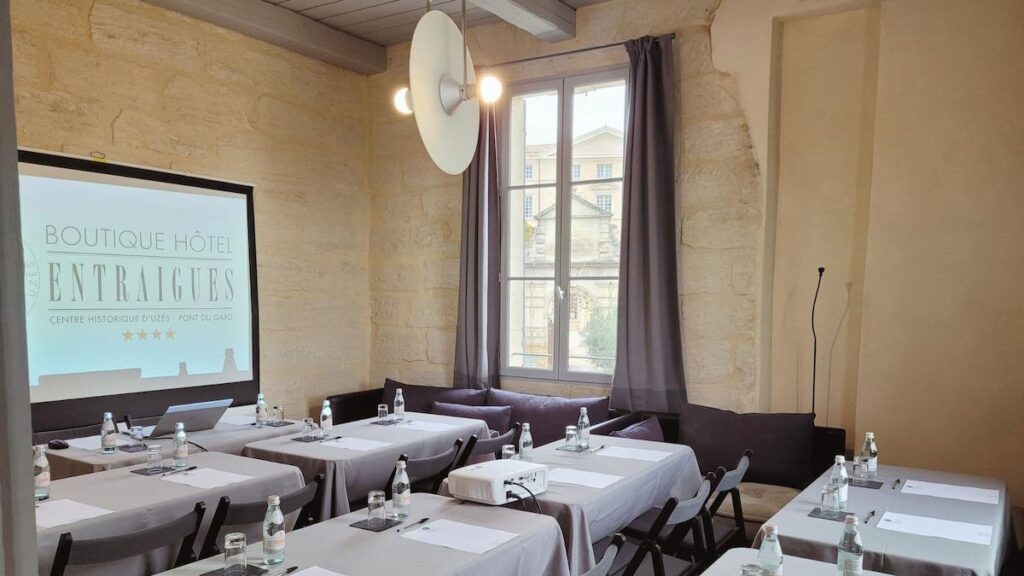
Discover the Boutique Hôtel Entraigues in Uzès, a charming 4-star hotel perfect for hosting your meetings or study days to strengthen team cohesion and refine your CSR approach. This boutique hotel and art gallery features a private garage, a swimming pool and panoramic terrace with views, breakfast included, and 19 character-filled rooms to welcome you in the very heart of the city center of Uzès, in the Gard department.
An accessible destination in Occitanie
Uzès is accessible by train and LiO coach, two modes of transport that help reduce your company's carbon footprint while saving you time. By car, the city is located less than 30 minutes from Nîmes, 40 minutes from Avignon, and just under an hour from Montpellier.
Local and authentic experiences
Enjoy the restaurants in Uzès during your eco-friendly team building for Gard gastronomy and market-fresh produce, hike through the garrigue with your colleagues, or try canoeing and kayaking near Uzès, close to the majestic Pont du Gard.
Proximity to eco-responsible activities
The Gard is a thriving southern department with an increasing number of green businesses, ranging from restaurants and event venues to swimming pools and wellness centers featuring environmentally friendly practices. The city of Uzès attracts many of these businesses, making it the ideal location for your residential seminar.
Checklist for a successful responsible event
To turn your good intentions into a concrete and memorable event, rigorous organization is essential. Here are three key steps to check off to ensure the success of your managerial seminar or committed team building.

Define CSR objectives
Before choosing a venue, determine the eco-responsible guiding line for your event. Would you like to focus on zero waste, prioritize a 100% local immersion, or center your workshops on climate awareness? Setting clear and measurable CSR objectives (for example: banning single-use plastic, offering a 100% vegetarian or local menu for a day) will serve as your compass. This will allow your organizers and their teams to align every detail of your stay, from the meeting room setup to the coffee break choices, with your company's philosophy.
Measure the carbon footprint
A successful responsible seminar is one whose impact can be evaluated. To achieve this, integrate carbon footprint measurement right from the planning phase. Take into account the major areas: transport for your team (by encouraging trains, carpooling, or shuttles), accommodation, catering, and team-building activities. By using online simulators or specialized event eco-design tools, you can obtain a concrete assessment. This analysis will not only allow you to offset your residual emissions but also to improve from one year to the next.
Communicate your commitments
Communication is the glue of your CSR approach: it must be transparent, authentic, and free of greenwashing. Upfront, involve your teams by explaining the project's origins (choice of an accessible destination, event charter). During the seminar, give meaning to their presence by highlighting the host venue's initiatives (such as our reasoned water management policy or our short supply chains for breakfast). Finally, after the event, share the results: thank your employees for their involvement, communicate the avoided carbon footprint, and share photos of your activities in nature. This is how you will sustainably strengthen your employer brand.
FAQ on eco-responsible seminars
Why organize an eco-responsible seminar?
It is an opportunity to align your strategic objectives with your environmental commitments. This type of event gives meaning to your team-building moments, unites your staff around strong values, and concretely enhances your employer brand among talent who are increasingly sensitive to current issues.
How to reduce the carbon footprint of a seminar?
To minimize the carbon impact of your event, prioritize national or regional destinations accessible by train and encourage carpooling. Opt for hotels and restaurants featuring local produce while limiting food waste. Reduce paper usage, ban disposable promotional items, and prioritize reusable digital media.
Which venue to choose for a sustainable seminar?
Opt for a human-scale establishment, ideally a boutique hotel or a charming hotel, committed to a concrete approach (sustainable water management, short supply chains, controlled energy). A venue rooted in its local area or set in the open air will also provide the ideal setting for your teams to disconnect.
What are the 4 pillars of an eco-responsible seminar?
The 4 pillars of an eco-responsible seminar are as follows: choosing an ecological venue, sustainable mobility, waste reduction, and local anchoring.